

The Eagle Bride
Once again on story, attention, and...
I was told something once I will never forget. Bear with me. We’ll have to take the long way around.
I spent many years in this world believing that the forces that guided us were explicable and finite. Matter attracts matter, sure—but in eddies and fits. There are many attractions only poets can articulate, or invoke.
A good story is impoverished by articulation. Well, the story itself is not, because a good story defies articulation. But the particular experience of a story, of that telling or that hearing, dilutes in proportion to explication.
Apparently story has become a secret language that few understand. This was not always so. Literacy, for one thing, is a tragedy from which our species has not recovered. Amplified sound is another. We who listen with headphones learn to hear with our ears only, which is a small fraction of the experience of hearing.
The cinema cannot be replicated at home. It is anyway a poor substitute for a gathering around the hearth, but it shares enough. The focal length, for example (staring into the fire means to stare beyond the fire). The collective attention. Light, dark, stars.
The cinema does not necessarily carry the attention born of heat, the desire to guard our backs against the night’s cold and to lean ever forward into the heart of the story. We crave a repeated voice, the voice of a trusted teller, over and over, recognizable faces. And the bone-rattling sound, enveloping, bowel-moving, tea kettle-high. And, of course, the ritual of it. It begins, it proceeds, it ends. Designated ritual time-outside-of-time.
A well-told story only works when it is well-listened to. In this age of inundation, where poorly-told stories are as bountiful as poorly-processed food, and where narrative warfare is waged outright among entities which are fed by attention alone, I understand the drive to and art of guarding one’s attention. So: which stories are worth giving attention to?
The short answer is: you have no choice which stories will worship through you, which will stay with you, and which will be told again through you. Not for the stories themselves. Let me ask again: which tellings are worth giving attention to?
Tom Hirons once said, I used to judge the success of my told stories by whether an audience laughed; then by whether they cried; now I judge whether a story is well-told by whether the fibers of reality hum along.
The tellings worth listening to, in my opinion, are those which reflect and relate with the natural laws of the world. And this means you must attune to the natural laws of the world; and you must give the storyteller a chance. And this means you must live life, and pay attention to the world, and be present with the speaker. And this, these days, is asking a great deal.
As best as I can tell, those who read information, and write informatively, cobble together a world of component parts, and believe the best way to convey the world to others is by delivering the parts and a schematic of their assembly. If it’s not clear by now, I’m attempting to speak their language. And, at the same time, for those who are listening, I’m attempting to subvert it.
Online writing is settled into a pattern which suits people who view the world so. Look at all the little interconnected parts.
This medium is a tragedy of the oldest kind, for what was unified long to be disparate, and what is scattered longs to unite. And some will argue that this venue is a place for such scattered parts to gather. But I am not speaking of gathering all the beasts under one roof, however benignly they might regard each other.
The old stories point toward harmony. And this venue is harmonious (almost homogenous) in its expression, except for those who already well-tread these woods. This venue encourages a certain kind of hearing, which is broad and not deep, and which is quick. Quick to ingest, quick to respond. This is very good for some kinds of interaction. One can take a hundred ideas with minimal regard, and put them in a stew, and drink the distillation of them, and I doubt any two people will drink the same stew, so it makes for a great proliferation of minor variations on a single theme.
There is a class of experience that takes time. It takes time to render the context for the experience, and it takes time to experience, and it usually must sit in a body for a long time before any attempt is made to communicate it, and then it is only communicated in a proper context, to a particular audience. Most of the wisdom of the world has been shared this way. And such experience, I’m afraid, is occluded here.
There is an anecdote I believe worth sharing. I suspect I am not alone in wishing for good guidance in these times. This didn’t happen to me, but I believe in learning from the experience of others. Thank you, Clarissa, Dr Estés, for telling this story to me in an honest way.
This happened about ten years ago. I was not present for much of this, but I trust the voices who told me, so I feel comfortable repeating it here, though I will omit names.
The farming family next door to us did well enough for themselves, a father and his three boys. They farmed all we did: corn, beans, nightshades. Their livestock was healthy.
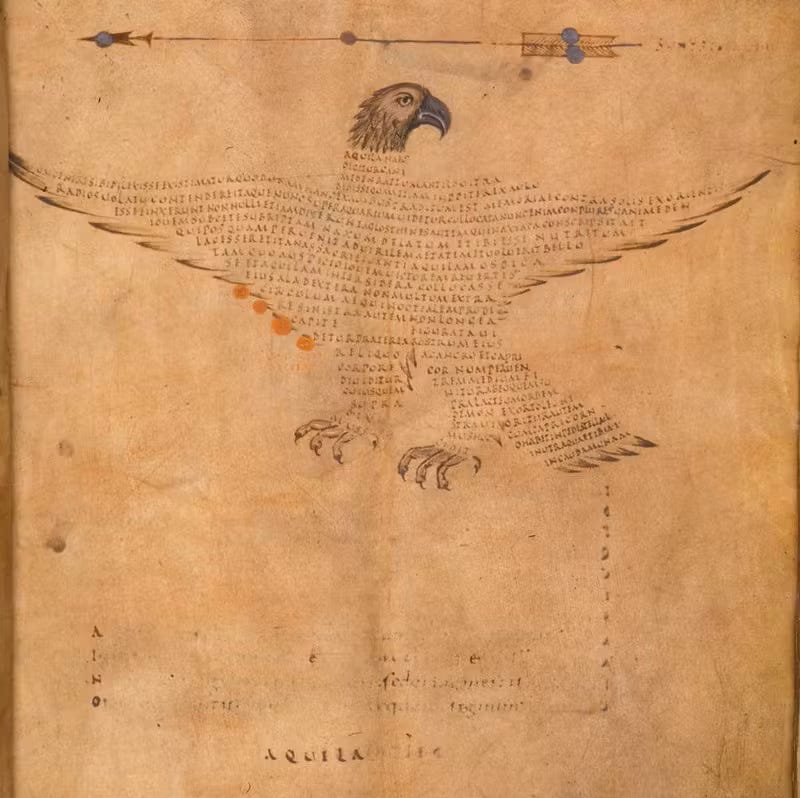
All that season the youngest son would walk to the same section of field, day after day, without appearing to get any work done. He wasn’t working. He was adoring an eagle who alit every day on the same tree. I only saw her from afar, but she was certainly beautiful.
He was jealous of her, and answered me with feigned ignorance. What eagle? So I left them alone to their long days.
She came to the tree to see the boy, as he came to the tree to see her. I never heard them speaking, so I don’t know what was said between them, except one day.
The farmer and his older sons were first frustrated, then angry at the fact of their working while the youngest son idled. They knew the reason for his neglect, and they conspired to kill the eagle.
The eagle, with her piercing senses, saw their conspiracy, and read their intent, and let the boy know that she could not stay there, and must return to her land in the high passes.
The boy begged her not to go. But she knew she must, to save her life. And the boy begged her, Let me come with you! He tore at his chest and howled.
She said, It is very different there. We fly in straight lines between our perches, and we do not cook our meat, and it is very cold there. We descend for water, but live in the thin, dry places.
The boy said, No, no, you don’t understand: I love you. I want to be with you. Wherever that may be.
And she relented, and bore him on her back to the Eyrie, to the Eagle Kingdom.
It was a long way, and tiring to bear them both, and when they arrived, the elders stood in a cypher with folded wings and glared at the boy. Looks soft, this one. Looks heavy. They demanded, What can you do for us? Their eyes were terrible.
The boy said, Well, I can do… I can… You know, I bet I can do anything you tell me to do.
With hardly a glance between them, the elders brought out an eagle coat. It was magnificent, amber down the back with long pinions. It hardly made a sound. The elders said, You will wear this coat and deliver messages between our kingdom and the other Kingdoms of the Air.
They said, You are to deliver messages swiftly; and faithfully; and you must never fly to the south. Do you understand?
The boy did understand, and put on the splendid coat, and set to his task. He had never dreamed so sweet a thing as riding the air on the feathers of eagles.
He delivered many messages, and did so swiftly, and faithfully, and without flying to the south. He performed his duty with care and relish. The boy learned all the invisible routes between the Kingdoms of the Air: those of the corvids, of the parrots, of the lesser songbirds.
He heard of lands given to flightless feathered beings, and furry flying things, and he suspected his duties would one day take him there. The world was vast.
The elders commended his work, and welcomed him at last, and permitted him to marry his dear eagle, who had borne him to the Eyrie.
They did marry. The boy wore his long-feathered coat, and the eagle bride gutted a mountain sheep for the banquet. And the boy flew every day.
He flew every day, and some days the feathers on his nape rose as he caught a hot wind from the south, and he thought, I wonder…
He thought, I wonder… what could be the harm? And I wonder what they are hiding from me in the Southern lands.
The air was so warm it lifted him almost without effort. And after a minute, he turned and continued on his way, trading messages with the other kingdoms.
That wasn’t so bad, the boy thought. Tomorrow, I will fly a little farther, even as I remain careful.
The next day, he flew a little farther south, and the air was hot. Far down below, the boy saw little figures in the field. He waved. They waved back. That wasn’t so bad, the boy thought. Tomorrow, I will fly down to them and greet them.
But that evening, when he returned to the Eyrie, the elders were waiting for him in the folded storms of their shoulders. Where have you been? they asked.
The boy said, Well, I flew a little to the south—
You flew all the way to the south! they said, and now you have doomed us all.
The boy said, How do you mean, doomed us? No, hear me out: I only flew a little south, and saw people there, and greeted them, but didn’t fly down—
You have waved to the people in the Land of the Dead, and now we must go to the Great Dance, and if we don’t dance well enough, or long enough, it will mean our lives.
Our lives! The boy watched as all the people of the kingdom dressed in their finery, and preened their coats, and arranged their crowns in grave silence.
The elders told the boy, Whatever you do, don’t dance. Don’t speak, don’t eat, don’t drink, and don’t laugh—and all this may turn out alright yet.
The eagles of the kingdom set out for the Land of the Dead, a glittering and somber formation. The boy pondered their fate and his part in it.
At the Great Dance, the fire burned high, and the banquet was exquisite, and the drums hammered the heart of the boy. And the eagles danced.
They wheeled and sweat and the bonfire singed their coats. The music rolled on. The boy sat very still. The eagles danced as if they had prepared for this their whole lives. The boy watched the eagles with wonder, and had to coax his muscles to dream quietly, because the motion of the eagles sowed loud dreams in him.
When it grew so late it became early, the eagles perched to rest, and the drums ceased. They had danced well, and long. Relief swept over them all. And dancers came out, beautiful young women, singing praise, and sweeping through the flying ones. Four of them circled the boy, and danced just for him.
Come with us, they whispered, to the fields, where we will make love all night. Love—all night—in the fields. Come with us— and the boy saw the other eagles had gone, probably out to the same fields, and he went with his young, beautiful hosts.
All night they made love, the boy and the dancers, in the fields, in the warm winds of that land. He hungered, but did not eat. He thirsted, but did not drink.
And in the morning he reached out in half sleep to caress the shoulders of his lover. He brushed away the dust from dry bone, and he realized what he had done.
He sprung up from the pile of bones and ran, ran across the fields, as fast as he could, with his coat trailing behind him.
And the bones, too, sprung up, and ran, ran across the fields behind the boy, clacking and chattering and never relenting.
After a long while, the boy saw a badger hole, and jumped into it. At the bottom of the hole he found a door, and, relieved, passed through it, and closed it behind.
A staircase descended from the door. Although it was dark, the boy fled quick as he could down the stairs. Down and down and down. At the bottom of those stairs, he found another door. He opened the door and found more stairs.
What choice did he have? He descended.
Two more flights he descended, and through the last door he found, at last, a stairway going up. Tired though he was, the boy pressed on.
Up the stairs, and through a door, and up another flight, and through another door, and up again. Breathless he climbed, hot in his coat, clumsy in the dark.
This staircase was long. Up and up he marched, two stairs to a step, then one, and finally treating each as a landing, panting, fearful of the clatter of bones.
He opened a heavy door, and found himself high in the Eyrie, in the house of grey stone, with the circle of elders awaiting him, wings folded.
The boy was too winded to explain. The elders felt no need to explain. They brought forth a ragged coat, missing feathers, with no shine to it.
The boy sobbed and shed his beautiful eagle coat, and donned the ragged one. He was led to the edge of the Eyrie.
You have brought nothing here, said the elders, but ruin. Your fortune you must seek elsewhere. And they pushed him off the ledge.
The boy flapped, and floated, and almost flew. But he was tired, and the coat was poor, and he began to plummet, eyes full of fear.
It was his wife appeared then. She came up under him, and bore him up. He would flap, and falter, and again she would bear him up.
She was tired, and he was tired, and they didn’t know their direction, but together they flew, in fits and starts, away from the Eagle Kingdom.
And something in her—she couldn’t say just what—looked at him all of a sudden with a fury, or even a hatred.
She turned and whipped, and raked at him. His poor coat shredded in her talons, and he fell, and fell down to the fields he did not want to work, the fields he had left.
Down he fell to the fields of his homeland, where he had once found an eagle in a tree, and voyaged to her every day. Down he fell to those fields, and he died there.
So I have heard, and pieced together, as best and plainly as I can. Dr Estés says all this happens at night, and I’m inclined to believe her. And maybe you have worn feathers yourself, and know the places I speak of. Maybe only the extreme parts of you remember. Maybe you say none of this can be true. No matter.